Love and Entropy
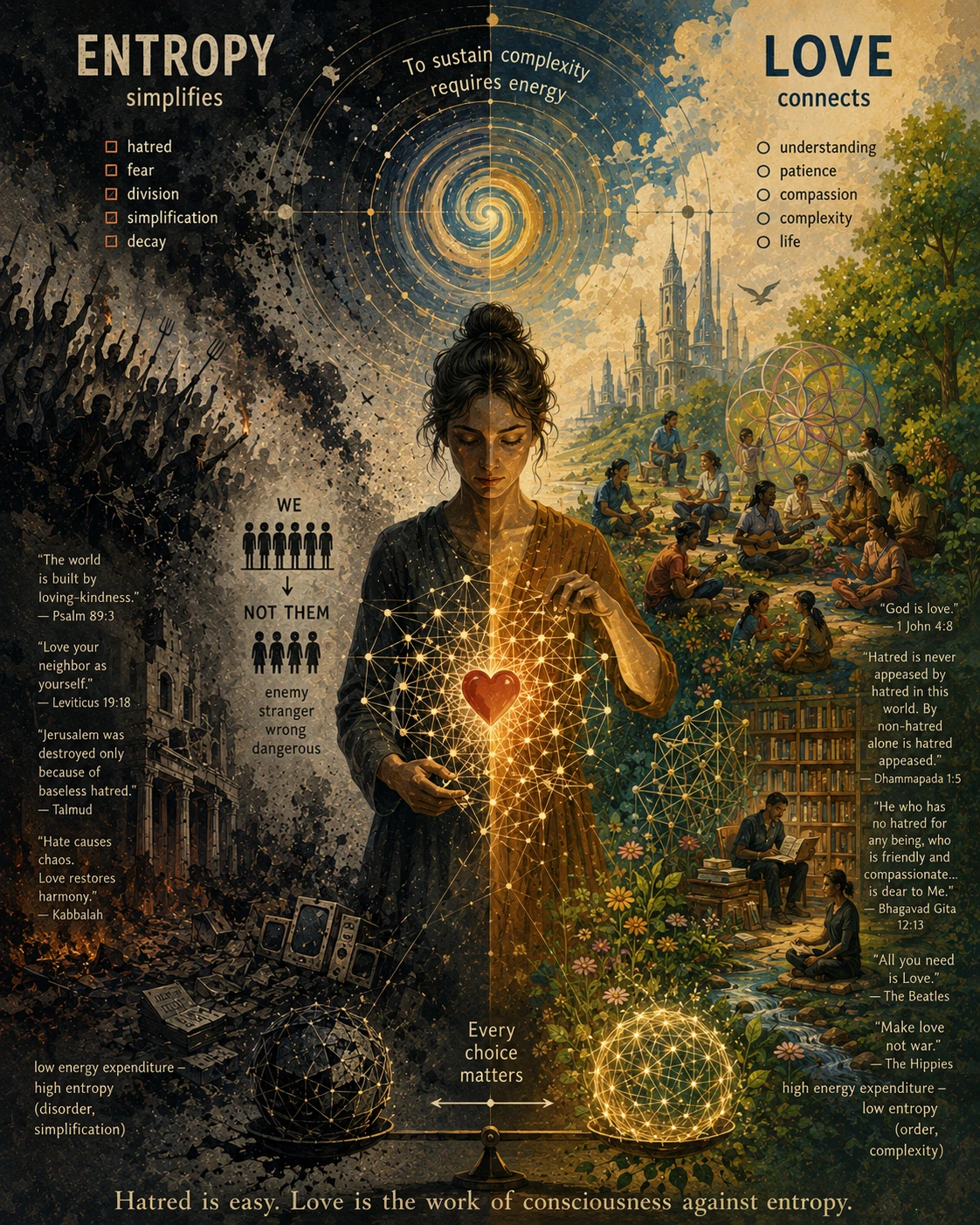
Hatred is far easier than love. Hatred is remarkably convenient. It simplifies the world. It reduces a multidimensional human being to a short formula: enemy, idiot, outsider, dangerous, wrong. After that, thinking becomes easy. Doubts vanish, the need to understand vanishes, inner complexity vanishes. A simple binary scheme emerges: “us versus them.”
Love works in exactly the opposite way. It demands that you hold complexity. To see a person whole — simultaneously strong and weak, beautiful and absurd, close to you and irreducibly separate. Love requires tolerating contradiction, uncertainty, the gap between expectation and reality. In other words, it requires a constant investment of energy to maintain a complex structure.
In natural philosophy, somewhat simplified, entropy is the tendency of a system toward simplification and the decay of organized structure. The world left to itself rolls happily downhill: order crumbles, connections break, complex forms degrade. Maintaining structure requires energy. Life is a local anti-entropic process. An organism continuously expends energy simply to avoid falling apart.
In the social sphere, culture does exactly the same thing. It accumulates, it complexifies, it demands ever greater effort to sustain, ever greater energy just to inhabit. It is far more economical to be a barbarian. Everything is simple, nothing needs to be learned, nothing needs to be taken into account. This is precisely why barbarians have always hated the intelligentsia. And having seized a city or a country, their first act is to burn the libraries.
Love also creates connections between complex systems without destroying their differences. It does not turn another person into property, nor dissolve them into itself. It maintains connectedness without destroying complexity. Hatred, by contrast, is deeply entropic. It dismantles the structure of another person’s personality in our perception. It reduces the picture of the world to a primitive schema. It is almost always energetically cheaper. This may be precisely why mass movements are so easily built on hatred and so rarely on love. Hatred instantly creates identity: “we are not them.” Love requires a far higher degree of inner organization.
In many pagan systems, the central place was occupied by a god of war, vengeance, or chaos. A god of love existed, if at all, almost exclusively in the erotic sense — Aphrodite, Freya, Hathor. Love as a cosmic, binding force opposed to disintegration — that is something else. And that something else comes later.
The first breakthrough was Judaism. ״עוֹלָם חֶסֶד יִבָּנֶה״ — “The world is built on loving-kindness” — Psalms 89:3. Roughly the ninth century BCE. ״וְאָהַבְתָּ לְרֵעֲךָ כָּמוֹךָ״ — “Love your neighbor as yourself” — Leviticus 19:18. Earlier still. In the Middle Ages, Judaism speaks in language that sounds almost thermodynamic: ״לא חרבה ירושלים אלא מפני שנאת חינם״ — “Jerusalem was destroyed only because of baseless hatred” — the Talmud. The kabbalistic ״אהבת חינם״ — “baseless love,” set against ״שבירת הכלים״ — the shattering of cosmic harmony — resonates remarkably with the Beatles’ All You Need Is Love and the hippie slogan Make Love Not War.
The same in Christianity: “God is love” — First Epistle of John, a text so early that Christianity in it is still a branch of Judaism. The same in Buddhism: “Hatred is never appeased by hatred; it is appeased only by non-hatred” — Dhammapada 1:5. The same in Hinduism — Bhagavad Gita 12:13: “He who bears no hatred toward any being, who is friendly and compassionate… — he is dear to Me.”
The great monotheistic traditions — including, with some qualification, the later forms of Hinduism, and Buddhism not in its folk incarnation of idol-worship and offerings, but in its philosophical one — all without exception are built on the idea of overcoming chaos, complexifying the system, reducing entropy. All of them point in the same direction: not dissolution but binding. Not reduction to the simple, but the capacity to sustain increasing complexity without collapse.
In this sense, love turns out to be not a “sweet emotion” but one of the most energy-intensive things in the universe. And this is precisely why it is fully within the capacity only of an omnipotent God. Human beings are creatures subject to the laws of thermodynamics. It is more convenient for them to hate.
Alex Lugovskoy