There is an old paradox familiar to anyone who has ever tried to choose a doctor, a lawyer, or a repairman without being a doctor, lawyer, or repairman themselves: to evaluate an expert, you would need to be an expert yourself — but if you were, you wouldn’t need the expert in the first place. Trust in someone else’s knowledge has to be extended blindly, and yet civilization rests on precisely this blind trust. We fly in aircraft designed by people we will never meet, swallow pills synthesized from formulas we cannot read, and eat food whose chemistry we have never tested. The question is not whether we should trust experts — there is no choice — but what exactly makes that trust justified rather than merely convenient.
The first and naive answer is this: trusting an expert means trusting their knowledge. The expert knows what I do not, and therein lies the source of their authority. But on reflection this answer explains almost nothing. Knowledge in itself is invisible. I cannot see what is in a person’s head; I see the diploma on the wall, the white coat, the confident tone, the citation to a publication. None of this is knowledge — it is the signs of knowledge, and those signs are detachable from the thing they signify. A charlatan can wear the coat, a liar can speak with confidence, a mediocrity can festoon himself with diplomas. Knowledge is real, but the uninitiated have no direct access to it. We trust not knowledge but the marks of knowledge, and the whole question is how reliably those marks are bolted to reality.
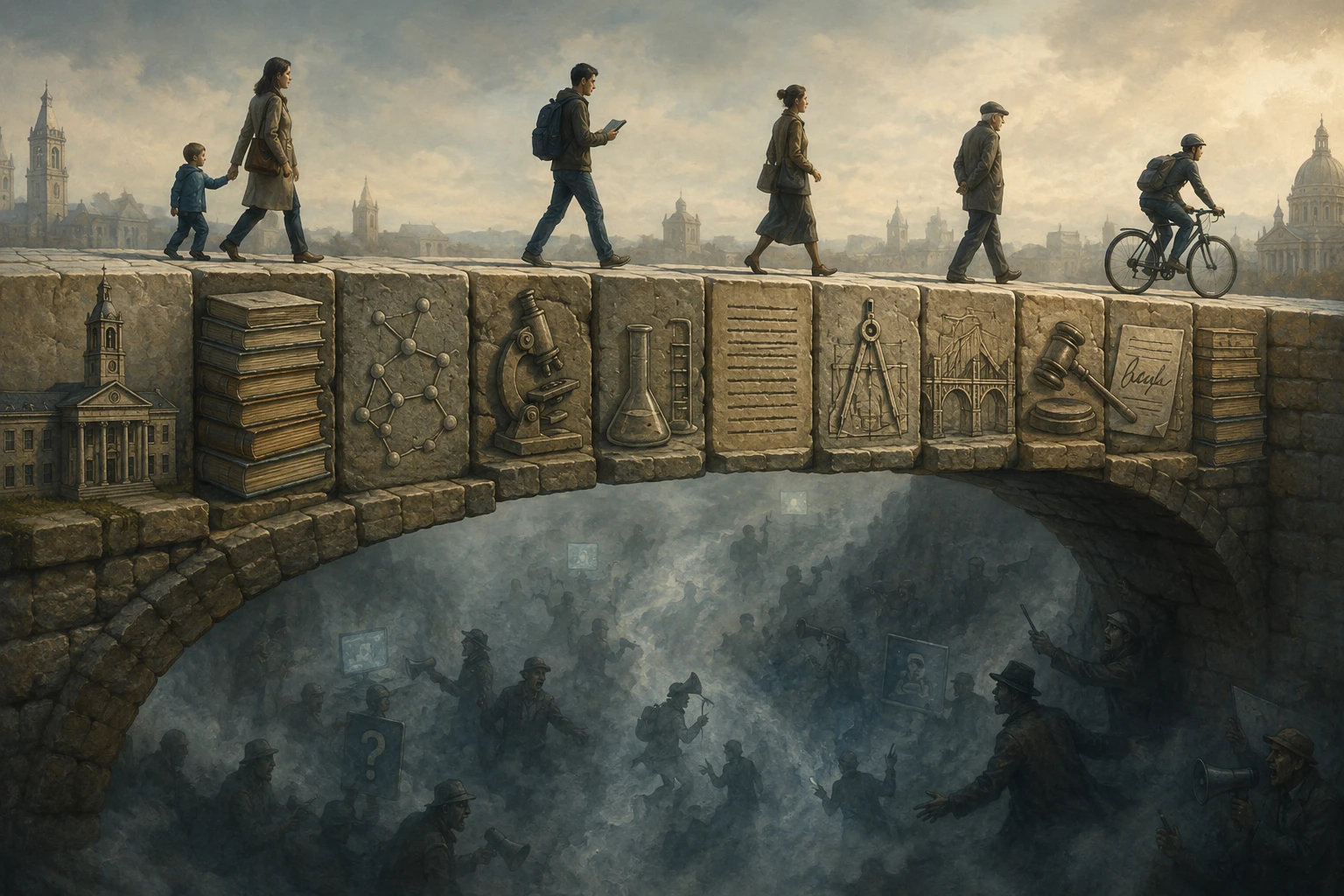
This is where it gets interesting. Because the coupling between knowledge and its outward signs is not a property of an individual but a property of institutions. A diploma carries weight not because the paper is magic, but because behind it stands a university that examined, tested, and weeded out — a university that is itself placed in conditions where handing out diplomas to just anyone would ruin it. A scientific paper is weighty not on its own, but because it passed peer review, because it can be cited and contested, because there exists around it a community ready to pounce on an error. An institution is a machine for converting invisible knowledge into checkable signals. It takes on the work of verification that an isolated layman cannot physically perform, and it does that work once, reliably, for everyone at once.
Put differently: an expert deserves trust not as a person but as a node in a network. Behind a good engineer stand textbooks he did not write, standards he did not ratify, past catastrophes learned from not by him but by his discipline. When I trust a bridge, I am not trusting the designer — I am trusting two centuries of structural mechanics paid for in real collapses. Expertise is always collective memory compressed into a single person. And its trustworthiness is directly proportional to the health of the tradition the person emerged from. A lone genius outside any tradition arouses legitimate suspicion — not because lone geniuses are never right, but because we have no cheap way to tell him apart from an equally lonely crank.
Hence the second pillar: reputation. If the institution answers the question “where did the qualification come from,” reputation answers the question “what did the person do with it afterward.” Reputation is a history of bets. Every forecast, every operation, every signature on a blueprint is a wager that came off or didn’t, and reputation is the accumulated record of those wagers, visible to others. Its value lies in being expensive: it takes years to earn and can be lost in a day. It is precisely this asymmetry that makes it a signal. A person who has something to lose finds it unprofitable to lie — not because he is more virtuous, but because the cost of exposure is higher to him than the gain from deceit. Trusting reputation is, in essence, trusting that the expert has a hostage: his own future.
But here too lurks a trap that the philosopher Nassim Taleb would call the problem of skin in the game. Reputation works as a guarantee only if the expert bears the consequences of his mistakes. An architect who lives in the house he built deserves more trust than a consultant who writes a report and vanishes. Whole classes of modern experts are arranged so that the glory of success accrues to them while the reckoning for failure falls on others: the analyst whose forecasts failed moves on to the next firm; the official who approved the doomed project gets promoted. When the link between judgment and consequence is severed, reputation stops being an honest signal and turns into pure theater — the skill of seeming, divorced from the skill of being. And the public, sensing this rupture, begins — rightly — to trust less.
Which brings us to the third and most fragile pillar: public trust as such. One might suppose that society’s trust is simply a consequence of the first two things: there are institutions, there are reputations, therefore trust will follow. But the relation also runs the other way, and it is precisely this feedback loop that decides everything. Institutions themselves rest on trust in them. A university carries weight as long as society agrees to treat its diplomas as meaningful; science is authoritative as long as the public believes that peer review is a filter and not a mutual back-scratching arrangement. Trust here is not a passive reflection of quality but an active condition of its existence. Undermine faith in an institution and it will — even while retaining all its former competence — cease to perform its function, because that function was social from the start. Expertise without trust is like money no one believes in: the paper remains, the value evaporates.
And here modernity poses us a particularly vicious question. The old system of trust was arranged hierarchically and economically: a few gatekeeping institutions that vetted a few experts whose judgments many people trusted. It was cheap precisely because the points of verification were few. The internet blew up that economy. Now the gatekeepers can be bypassed, anyone can present the signs of expertise to the public directly, and the public, stripped of its former filters, finds itself facing a choice it is not evolutionarily equipped for: to distinguish knowledge from its imitation alone, in the stream, without intermediaries. No wonder people grasp at ancient, pre-rational heuristics — confidence of tone, charisma, membership in one’s own tribe. These signals worked when the community was small and everyone knew everyone; at the scale of millions they become exactly what is easiest to manipulate.
So what, in the end, makes expertise trustworthy? Not a single property but a whole ecology. Knowledge supplies the content, but it is invisible. The institution makes it checkable, but the institution itself needs trust. Reputation ties judgment to consequences, but only where the skin is genuinely in the game. And public trust, crowning all of it, is not a reward for competence but the living medium in which competence can mean anything at all. Remove any one of the floors and the building does not merely weaken — it changes its nature: knowledge without institutions turns into esoterica, institutions without reputations into bureaucracy, reputations without consequences into spectacle, and the whole thing without public trust into a heap of regalia no one needs.
Perhaps the most honest thing one can say is this: trustworthy expertise is not something a person possesses but something maintained between people. It rests not on genius but on a chain of mutual obligations stretching from the anonymous researcher through the reviewer, the editor, the teacher, the engineer — down to the one who, in the end, trusts the bridge he is walking under. Each link in that chain takes on a fragment of the verification the others cannot perform themselves. And when we ask whether an expert can be trusted, we are really not asking about him alone — we are asking whether the whole chain is intact. In an age when the links break more easily than ever, that is perhaps the central question: not “whom to believe,” but “what we are willing to pay to keep trust possible at all.”
Marcus Reeve